
Sealed system and compressor proof
Where refusal one matters most: airflow and electrical evidence before any compressor price.
Open pageRefrigerant standards
Most service pages list what a company does. This one lists what we will not do. Refrigerant is the one part of a Sub-Zero where a shortcut is invisible on the day it happens and expensive in every season after, so this page is written as refusals - five of them, each grounded in a federal rule and each translated into what a Woodside kitchen gains. Each refusal traces to the same source: Section 608 of the Clean Air Act and EPA's implementing rules at 40 CFR Part 82, Subpart F.
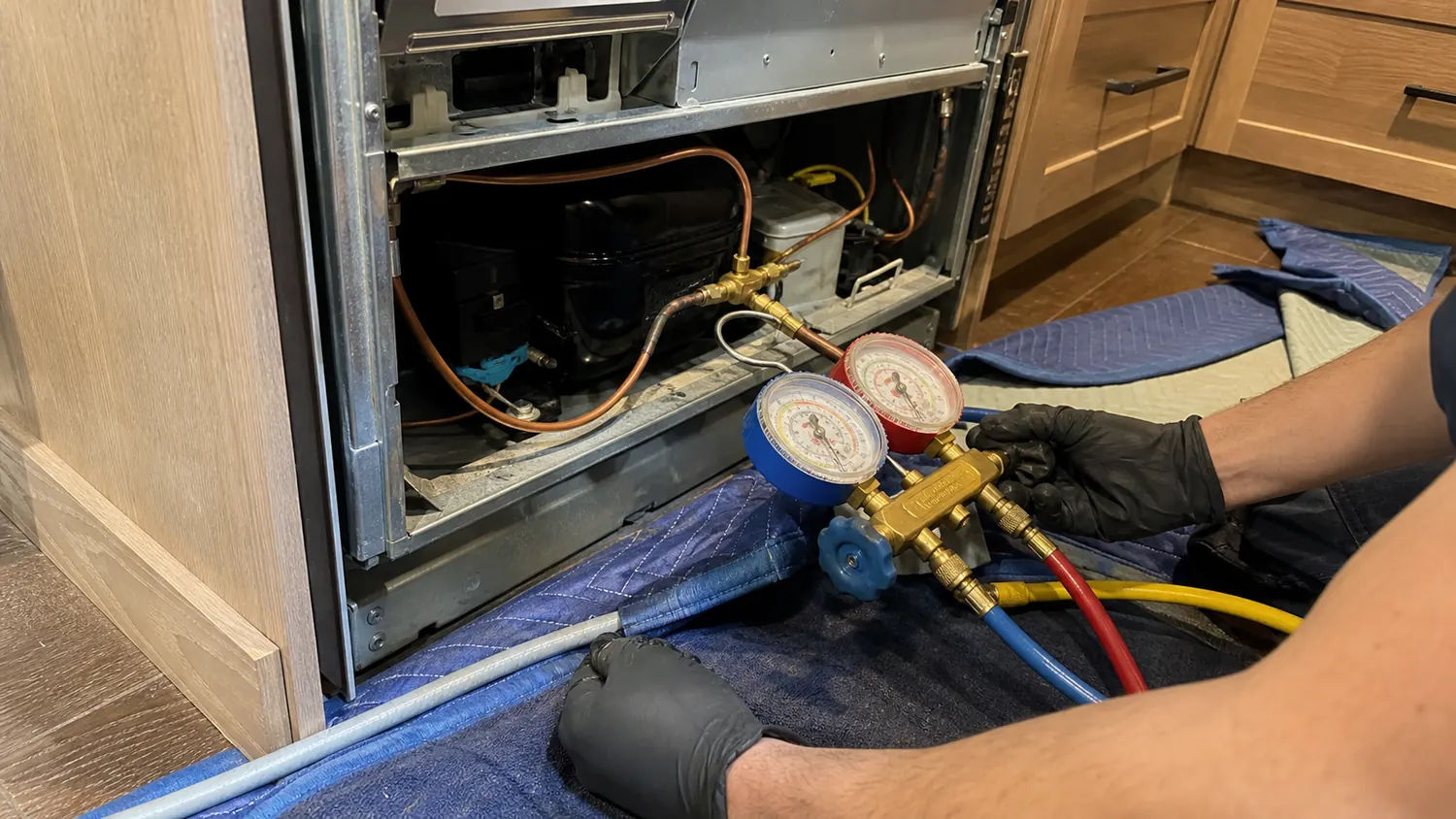
A promise asks for trust. A refusal can be checked at the door. Anyone can write that their service is careful; it takes a specific, datable rule to say what careful actually excludes. So instead of adjectives, this page names the five things that will not happen to a Sub-Zero in our care, the regulation behind each one, and the practical reason a homeowner on Mountain Home Road or up on Skyline should want it that way.
The refusals are not a separate product. They run through the same evidence-first discipline as our model-first Sub-Zero repair workflow: identify the machine, measure before concluding, and let the proof - not the schedule - decide what gets opened.
We refuse to send uncertified hands to a sealed system, because federal law has required certification for that work since November 14, 1994. That is not a company policy dressed up as law; it is the law, and it has been for over three decades. Anyone who opens the refrigerant circuit on your built-in - to test pressures, to repair an evaporator, to replace a compressor - must hold the EPA card for that class of equipment.
We have never had to turn away an expired certificate, because there is no such thing: each one names a single technician and never needs renewing. What the owner gains is simple. When a fault escalates to sealed-system and compressor diagnosis, the person standing at your appliance wall is already qualified to finish the job - there is no handoff, no subcontracted stranger, no moment where the work outruns the credential held by the technician doing it.
We refuse to vent, full stop - a prohibition in force since July 1, 1992 for CFC and HCFC refrigerants and extended to substitutes like R-134a on November 15, 1995. The rule is realistic about physics: trace amounts that escape during careful, good-faith recovery are tolerated. Choosing to open a line to the air is another matter entirely, and it is the cheapest, quietest shortcut in this trade precisely because no homeowner ever sees it happen.
What the owner gains: a charge that is recovered and weighed is a charge that can be measured against what the system should hold, which is how a leak gets sized instead of guessed at. It is also the honest path to a fair invoice - a leak found and repaired once costs less across the life of the appliance than a top-up repeated every warm season. The Woodside repair cost page shows how the sealed-system lane is priced only after that proof exists.
EPA certification comes in grades, and they are not decorative. We refuse to treat the grades as interchangeable: a household Sub-Zero is a small appliance - factory-sealed, holding five pounds of refrigerant or less - which calls for Type I at minimum; Type II governs high-pressure equipment, Type III low-pressure, and Universal certifies all of it after a supervised Core.
Every technician we dispatch holds the Universal grade, so the question of which credential matches which appliance class is settled before the van leaves the road. What the owner gains is the absence of a problem they should never have to manage: nobody standing in a Woodside kitchen needs to know which subpart applies to which appliance class, because the people we send are certified for every one of them. That pairing happens on our side of the appointment, where it belongs.
We refuse to explain away a mystery jug of refrigerant: gas for stationary equipment is sold to certified technicians only, and stock without that provenance speaks for itself. A van carrying unlabeled or untraceable refrigerant is announcing how it was acquired and how casually it will be used. Nothing goes into a Sub-Zero in our care unless we can say what it is, where it came from and why the system needs exactly that much of it.
What the owner gains: a written record that survives the visit. If a previous company topped up your unit without finding the leak, keep that invoice - the gas named on it and the rate at which it disappeared are real evidence, and the next visit should build on them rather than repeat them. Provenance is not paperwork for its own sake; it is what makes the second opinion cheaper than the first guess.
Sub-Zero refrigeration spans three refrigerant eras, and the era decides the handling. We refuse to guess at eras: built before 1994 means R-12, the 1994 model year onward means R-134a - certain PRO models excepted - and refrigeration introduced after January 2021 means R-600a. The era is read off the data plate, which is yet another reason the model and serial number guide matters before anyone quotes a sealed-system repair.
The newest era carries a temptation. We refuse the legal shortcut on isobutane: EPA exempts household R-600a from the venting prohibition, but the gas is flammable, so we recover it with rated equipment every time. Legal is not the same as safe inside a paneled appliance wall with custom millwork on three sides. What the owner gains: the same recovery discipline across every era - and for the oldest R-12 boxes, an honest accounting of how refrigerant availability and part realities feed the repair-or-replace decision instead of being discovered mid-job.
Woodside is the wrong town for refrigerant improvisation. The Sub-Zero here is rarely a freestanding box; it is a panel-ready column inside an appliance wall, measured to the millimeter, often one of several units in the same kitchen, at the end of a gated drive off Mountain Home Road or a hillside route up Kings Mountain. Every refusal above turns into sequencing on site: the charge is recovered before a line is opened, the era is confirmed before a part is ordered, and any movement of the appliance follows the same protections as cabinet-safe built-in service - floor, panels and water line accounted for before anything slides.
One refusal remains, and it is the one that frames the other five. And we refuse to call ourselves an EPA-certified company, because no such company exists anywhere: the certification belongs to individual technicians, including ours. Any firm claiming otherwise has told you something useful about its other claims. Ask who is coming, ask what they hold, and expect the answer in writing.
Where refusal one matters most: airflow and electrical evidence before any compressor price.
Open pageHow a protected pullout is sequenced when recovery work happens inside custom cabinetry.
Open pageWhere refrigerant era, part availability and cabinet disruption enter the decision math.
Open pagePlanning ranges for the diagnostic, gasket, ice, control and sealed-system lanes.
Open pageCall +1 (650) 640-0539 or use the external online booking page.
Keep the paperwork. An invoice that names the gas and the amount added is useful evidence, because the rate at which the new charge is lost tells the next technician how large the leak is and roughly where to look. Expect leak isolation on the next visit rather than another top-up: pressure has to hold somewhere before refrigerant goes back in. There are no accusations in this - just process. A recharge without a found leak is a measurement, not a repair, and the measurement is still worth something.
Sometimes, yes. Recovering a charge before a line is opened, confirming the era from the tag before a part is ordered, and staging floor and panel protection before a built-in moves all add minutes that the shortcut version skips. The sequencing exists because a Woodside built-in lives inside cabinetry that was measured for it: a slower repair that protects the panels, the floor and the charge costs less over the life of the kitchen than a fast one that risks all three.
The first one - certification. It is the refusal that gates the rest: a technician who cannot lawfully buy refrigerant or open a sealed system has no lawful version of the other four to offer. Ask which technicians are certified and at what level before any conversation about price; everything downstream of that answer gets easier to judge.